In most Indian flats, the children's room is the smallest bedroom in the house. It has to hold a bed, a cupboard, a desk for homework sooner than you think, and somewhere to play. Usually play loses, and the toys spill out into the living room.
It does not have to go that way. A small room can hold a proper play area if you treat it like a tiny home: a place to sleep, a place to work and a place that is entirely theirs. Here are kids room ideas with a play area that suit small Indian bedrooms, from where the house goes to how to keep the floor free.
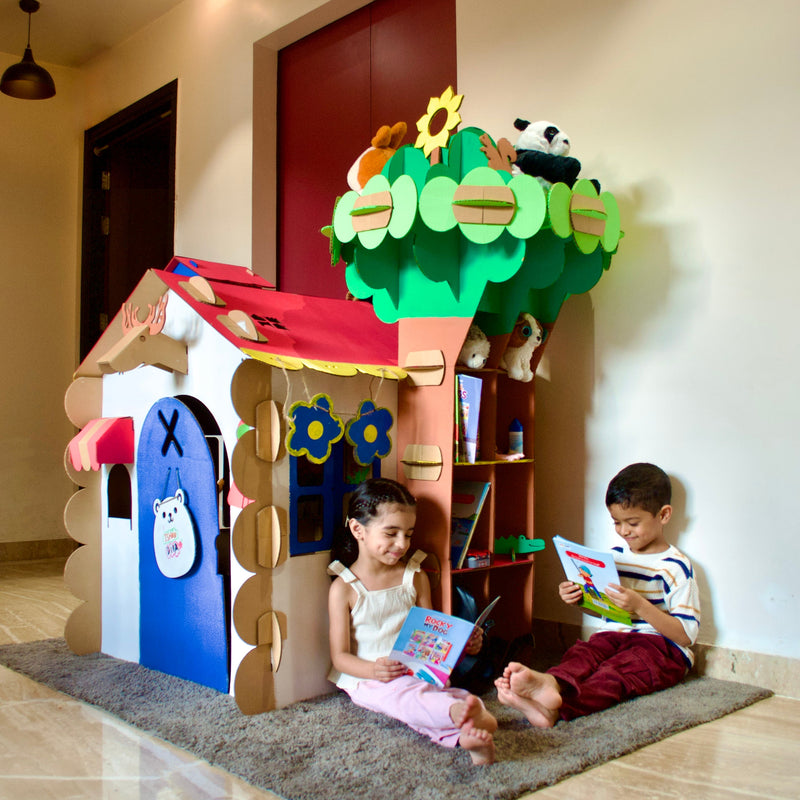
The quick answer: divide the room into three zones (sleep, work, play), give the play zone one good object instead of a pile of toys, and keep storage up the walls and under the bed. A DUDUK house makes the play zone. The Cubby House takes 80 × 88.5 cm of floor (₹2,899), the Rocket takes 82 × 82 cm, stands 170 cm tall and comes with 36 sheets of space stickers (₹4,299), and the Tree House takes 92 × 103 cm, with a bookshelf in its tree (₹3,300). All three are life-size, arrive flat with blank walls, slot together without tools and are made for children aged 2 and up. Delivery is free across India in 4–6 days.
Three zones in one small room
Interior designers zone large rooms all the time. It works even better in small ones, because each zone tells a child what happens there.
- Sleep. The bed along the longest wall, with a shelf or a couple of hooks above it for night-time things.
- Work. A small table near the window, for drawing, puzzles and, later, homework.
- Play. A corner of about a metre square, with walls of its own.
The play zone is the one parents leave out, and the one children feel most. Without it, play happens on the bed, on the desk and across the whole floor. With it, the game has an address, and so does the mess.
Where the house goes
Put the house in a corner, not in the middle of the room. Two walls behind it make it feel like a den, and the floor in front stays clear for walking.
- Measure first. Mark the footprint on the floor with masking tape and live with it for a day. If nobody trips over the tape, the house fits.
- Check the doors. The room door and the cupboard doors both need to open fully past the house.
- Mind the window. A house beside the window gets good daylight for reading. A house in front of it blocks the light for everyone.
- Choose the shape for the room. The Cubby House and the Rocket take about the same floor. The Rocket goes up to 170 cm rather than out, which suits a narrow room. The Tree House needs a little more, about a metre each way, and does the job of a bookshelf as well.

Every DUDUK house sits in a room as easily as a good chair: clean lines, blank walls and nothing shouting at you. On a dry weekend it can move out to the balcony too; just bring it in before rain. If space is really tight, our guide to fitting a playhouse into a small apartment has more ways to find the corner.
Walls they decorate: buntings and bird hooks
Children's rooms are usually decorated for children, not by them. A wall of decor they made themselves means more to a child than any wallpaper, and it can change as they do.
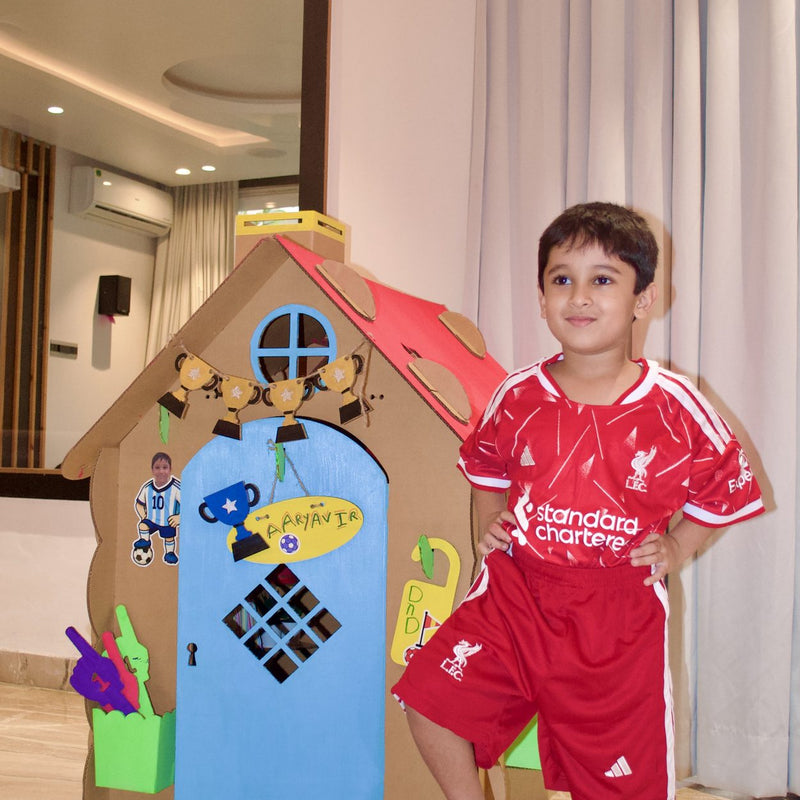
Start with bunting. DUDUK Buntings come as ten blank flags on natural jute twine (₹140), in five shapes: triangle, arch, ribbon, flower and a space set. Paint them together, thread them, and tie them across a window grille, over the bed or along the front of the house. No nails in the bedroom wall, which matters in a rented flat.

Bird Hooks (₹120 for ten) slot into any wall of a DUDUK house and pull out again without a mark. They are the place for a school bag, a hat or a dressing-up cape, and they take paint too. Hangers (₹59 for eight) are sized for doll clothes and dressing-up outfits, so one corner of the house becomes a tiny wardrobe.
You will find all of these in the decor collection, and more ideas in our guide on how to decorate a kids playhouse.
Storage that keeps the floor free
In a small room the floor is the play area, so the rule is simple: storage goes up the walls or under the bed, never across the floor.
- Under the bed. Two or three lidded boxes for the toys that are not in use this week.
- On the wall. A narrow shelf at your child's eye level for the things they use every day. If it is above their reach, it is your storage, not theirs.
- In the house. The Tree House's bookshelf keeps books at a child's height, and bird hooks inside hold bags and capes. The house does storage work while it is being a house.
- One basket. One basket of loose toys in the play zone. When it is full, something goes back under the bed.

Rotation does more for a small room than any clever furniture. Keep a third of the toys out and two thirds away, and swap every couple of weeks. Old toys come back feeling new, and the floor stays clear.
Sharing a room
Most Indian siblings share a room at some point, often with a big age gap. A play zone helps here more than anywhere, because it is neutral ground.
- Two beds, one house. Place the house between or opposite the beds, so it belongs to both.
- A wall each. Give each child a wall of the house to paint their own way: planets on one side, flowers on the other, and no arguments about colour.
- Two names over one door. Painting both their names over the door settles the question of whose house it is.
- Different ages, same house. A four-year-old and a nine-year-old play differently, but both use a house. The younger one plays house; the older one turns it into a reading den or a headquarters. DUDUK houses are made for ages 2 and up, with no upper limit.
The Tree House is the easiest to share. It has the most floor of the three, and a bookshelf both children can reach.
Decor that changes with the phase
A small room cannot be redecorated every time a child discovers dinosaurs, then football, then space. A house can.
Because every wall takes paint, the same house can be a bakery at three, a football clubhouse at six and a quiet reading den at nine. Paint over the old theme with washable tempera and start again. Change the bunting shapes, move the bird hooks, add a Football Themed Sticker Pack (₹79) or a Flower Kit of four paintable flowers (₹89).
Let the rest of the room stay calm: plain walls, simple bedding, light wood or white furniture. Let the house carry the colour. It is the one object in the room that belongs entirely to your child, and it should look like it.
To find the house that fits your room, compare all three in our collection of play houses for kids.
Because imagination is the fastest way to grow.